Posts

Soft, hard, and late deadlines (or another failed experiment)
Image
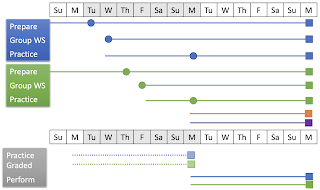
After my side channel experiment that wasn't worth keeping, it's probably no surprise that I did yet another crazy experiment! This one has a bunch of the usual elements. A naive teacher with delusions of lots of energy who thought this was a good idea (that's me). A class structure for who that teacher (me) wants the students to be, not how typical human students would behave. This time I messed with the deadline structure in my CompSci216 class, Fall 2021. This class is data science for students that have finished a CS2 level course or have enough programming and statistics that they'll be able to make up for having less programming experience. [Also posted on medium .] I knew going in that it wasn't the greatest of ideas. But I also thought it was an experiment worth trying (just like the side channel experiment ). Moreover, I couldn't think of a way to change it to increase the likelihood of success, so I ran with the idea anyway. I again framed it to the s...

Show me, don’t tell me

It is/was graduate application reading season! And you know what that means? Reading a bunch of statements and sometimes wondering where the applicant’s mentor led them astray. So I thought I’d write this post to voice my opinion on what part of what makes a good statement. [Also posted on  medium .] Show, do not tell A good statement should show me, not tell me about the applicant. And that’s a nuance that might be hard to picture at first. What I mean is the statement should provide enough information and detail that the reader can picture the applicant doing things as a grad student and researcher. It cannot simply say, “I’m a good learner.” It must show me they are a good learner by giving me an idea of what a good learner means to them, hopefully without actually saying it outright. An applicant should leave to their letter writers summary statements like “he is a hard worker” and “she is quick to learn new things.” Those letter writers have the reputation and experie...

State of the podcasts

Given that I have a podcast ( The CS-Ed podcast ), it should come as no surprise that I listen to many podcasts. So I thought I’d try something that I will call “State of the Podcasts.” This post will announce how to learn about all of the podcasts I listen to, and maybe I’ll write future posts on how my listening evolves. I hope that sharing this can serve as a resource for potential podcasts that others find helpful or interesting. [Also posted on  medium .] For a proper citation, I got this idea from the Cortex podcast that does a yearly “State of the Apps” episode discussing the apps they often use. I like that podcast for discovering potential apps that I might find helpful to include in my workflow. CGP Grey does a lot of research for his work, and I feel like our brains are wired similarly. So while much of what they use does not apply (I’m not a YouTuber nor multi-podcaster creator like they are), it is still a valuable episode for me. For example, I learned about https://...

Video chat side channel in a remote class (or an experiment not good enough to keep)

Video chat side channel in a remote class (or an experiment not good enough to keep) Talking about failure is hard. Talking about an experiment that didn’t completely fail but didn’t wholly succeed, is something that I could easily “sweep under the rug.” However, I think it’s important to share the good, the bad, and the ugly. It shows we are human and no one is perfect. Moreover, for this particular experiment, I could see myself rationalizing trying again, and I want to make sure I remember the lessons I learned. In Spring 2021, when we were teaching our CS2 class fully remote due to covid-19, I had a crazy idea. What if we gave students a second video chat outside the lecture Zoom meeting? What if we used this video side channel to simulate the “talk to your neighbor” practice that I used a lot in my lecture teaching? It did not go as well as I had imagined, and this blog post is a reflection on why we did it, how things went, and what we did when things weren’t working. [Also p...

(Virtual) ICER 2021 Reflection

ICER 2021 has come and gone, and it was my best online conference experience yet! Both in terms of how I handled it AND in how the organizers run it. I won’t give a detailed explanation of how ICER was run. Matthias Hauswirth, the site co-chair, made an excellent introduction video to the platform Clowdr . Not everything was perfect. But I think a lot of that was because I was new to Clowdr. After fiddling with my processes as the conference continued, I found things that worked. I’ve broken this blog post into socializing, useful processes/practices, my wishlist of changes, and highlights. [Also posted on  medium .] Socializing This online conference was the most social I’ve been to yet, and I loved it! I think part of it had to do with the benefit of lowering the number of tools/apps/sites that people are using and baking in the ability to socialize. SIGCSE didn’t have an easy way to socialize outside of the actual activities. ITiCSE had ohyay, but it was not in the platform the...

(Virtual) ITiCSE 2021 Reflection

I attended ITiCSE this year. One of my former undergraduate students, Anshul Shah, presented his paper on our CS1 reviewer app . Attending was an opportunity to iterate on how I approach online conferences and try out ideas from my last reflection when I attended SIGCSE 2021 . One way to describe my approach to ITiCSE is less like prior online conferences and more like how I approach in-person conferences . [Also posted on  medium .] How I decided what to do Step 1 : Look at the proceedings two-ish weeks before and note all of the things I find interesting.  — I did this based only on the titles. The abstracts hadn’t come out at the time. Step 2 : Go through the list a second time and mark which things I will actually attend.  — Talks were live, and the videos would not be available until after the conference. I often had more papers I was interested in than I had time for, so I needed to prioritize. I purposely separated this step from Step 1 because I didn’t want to get bo...

ITiCSE 2021 Paper: CS1 Reviewer App

Image
 ITiCSE 2021 is here! And this year, I’ve got a paper with Anshul Shah , Jonathan Liu , and Susan Rodger . The first two were undergraduate students. They are now both graduated and going on to grad school to study computer science education! Anshul is going to UCSD and Jonathan to Chicago . [Also posted on  medium .] The paper is “ The CS1 Reviewer App: Choose Your Own Adventure or Choose for Me! ” and is a tools paper. The paper introduces an app that Anshul originally developed with a partner in their Fall 2019 database class. We’ve been developing the app ever since with help from other undergraduate students through Duke’s summer CS+ program . Jonathan started helping last Fall. Below is a screenshot, the abstract, and a discussion of changes from the last six months since we submitted the paper. You can also check out the tool yourself at https://cs-reviewer.cs.duke.edu/ Abstract We present the CS1 Reviewer App — an online tool for an introductory Python course that all...