Posts

Handling Late Homework

(I have an updated version of this post as a guest post on Grading for Growth and a post on this blog with implementation details .) I’m going to take a break from my hybrid conference series and write a post about my latest attempt at handling late work. So far, this system is my favorite, and I plan to reuse it almost unchanged this coming semester. I created it to balance the needs of my students, my teaching staff, and myself. The single-line explanation for my late system is I used tokens to empower my students to decide when they’ll turn in late work. But the devil is in the details, and I put a lot of thought into how and why I set things up the way I did. This post will outline the system itself, what the students thought of it, what I thought of it, and my plans on what to do next time. [Also posted on  medium .] The Late Submission Token System This policy applied to the homeworks that were part of the course’s ten modules. They were released as soon as we had them...
Authors' Corner: A place for online authors' Q/A

 The Authors’ Corner was the brainchild of a SIGCSE TS 2022’s chairs meeting. By the time we articulated the idea, I didn’t know who contributed what to create it. The event aimed to enable authors to answer questions about their work online. The Authors’ Corner was primarily for online attendees and authors. [Also posted on  medium .] However, once we decided to do it, I said it had to be something where no one was left alone in a video call, “sitting in a black void,” waiting for someone to appear. The in-person equivalent event was presenters at posters or tables; if someone was interested in the project, they could talk to the presenter. However, the online versions of this I’ve participated in as a presenter and attendee put presenters in a video call alone, where they sat in a “black hole,” hoping someone would come and talk to them. Such events often make presenters feel insignificant and “unpopular” if no one comes, or maybe that’s just me. I refused to put our present...

Hybrid Conference: Questions to think through

  Hybrid Conference: Questions to think through Here is the first in my reflection series on running our first hybrid SIGCSE TS 2022 . In this post, I’ll cover a more organized version of the questions I’ve sent to those who’ve emailed me directly about running a hybrid conference. I did my best to cluster them so it isn’t an overwhelming laundry list of questions. But, to be honest, it is still an overwhelming list. Hopefully, the added context and extra ideas will help. Disclaimer: Opinions are my own. [Also posted on  medium .] This post is broken down into the following sections: Overall Experience (5 questions) Nuts and Bolts (3 questions) Videos? (2 questions) Hiring Help (2 kinds) Platform (1 question) Overall Experience (5 questions) Question 1: What kind of interaction/experience do you imagine for the hybrid piece? One person’s hybrid will not be another person’s since we have all experienced it differently. The organizers must be all on the same page. The only ...

Hybrid Chair for SIGCSE TS 2022

So this past March, I was the inaugural Hybrid Experience Chair for the 2022 SIGCSE Technical Symposium . This conference is the Special Interest Group Computer Science Education’s (SIGCSE) flagship conference with over 1,500 attendees. My career plans included serving on committees like this. However, I hadn’t planned to volunteer for such committees until my kids were older and starting in a much smaller role. [Also posted on medium .] But when I got the call, I couldn’t say no. Ever since the Covid-19 pandemic started, I’ve been talking about how we can’t go back to pre-covid times as we glacially return to some new normal. In-person conferences are exclusionary. I experienced that first hand with SIGCSE TS 2020, the conference that didn’t happen due to the pandemic. I was eight months pregnant at the time of that conference and therefore couldn’t travel. So I had to remove my name from a submission because it required attendance. I supported my co-authors but couldn’t actually go a...

Soft, hard, and late deadlines (or another failed experiment)

Image
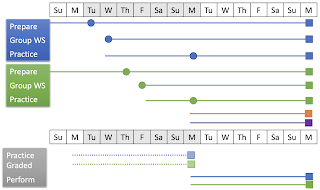
After my side channel experiment that wasn't worth keeping, it's probably no surprise that I did yet another crazy experiment! This one has a bunch of the usual elements. A naive teacher with delusions of lots of energy who thought this was a good idea (that's me). A class structure for who that teacher (me) wants the students to be, not how typical human students would behave. This time I messed with the deadline structure in my CompSci216 class, Fall 2021. This class is data science for students that have finished a CS2 level course or have enough programming and statistics that they'll be able to make up for having less programming experience. [Also posted on medium .] I knew going in that it wasn't the greatest of ideas. But I also thought it was an experiment worth trying (just like the side channel experiment ). Moreover, I couldn't think of a way to change it to increase the likelihood of success, so I ran with the idea anyway. I again framed it to the s...

Show me, don’t tell me

It is/was graduate application reading season! And you know what that means? Reading a bunch of statements and sometimes wondering where the applicant’s mentor led them astray. So I thought I’d write this post to voice my opinion on what part of what makes a good statement. [Also posted on  medium .] Show, do not tell A good statement should show me, not tell me about the applicant. And that’s a nuance that might be hard to picture at first. What I mean is the statement should provide enough information and detail that the reader can picture the applicant doing things as a grad student and researcher. It cannot simply say, “I’m a good learner.” It must show me they are a good learner by giving me an idea of what a good learner means to them, hopefully without actually saying it outright. An applicant should leave to their letter writers summary statements like “he is a hard worker” and “she is quick to learn new things.” Those letter writers have the reputation and experie...

State of the podcasts

Given that I have a podcast ( The CS-Ed podcast ), it should come as no surprise that I listen to many podcasts. So I thought I’d try something that I will call “State of the Podcasts.” This post will announce how to learn about all of the podcasts I listen to, and maybe I’ll write future posts on how my listening evolves. I hope that sharing this can serve as a resource for potential podcasts that others find helpful or interesting. [Also posted on  medium .] For a proper citation, I got this idea from the Cortex podcast that does a yearly “State of the Apps” episode discussing the apps they often use. I like that podcast for discovering potential apps that I might find helpful to include in my workflow. CGP Grey does a lot of research for his work, and I feel like our brains are wired similarly. So while much of what they use does not apply (I’m not a YouTuber nor multi-podcaster creator like they are), it is still a valuable episode for me. For example, I learned about https://...